
Import Indian Jaggery from India to the UK
Form, colour, composition, processing declaration, HS classification, the CETA sugar exclusion, supplier qualification, landed cost, packing and UK food-import decisions.
What the current official framework says.
These are classification, tariff, origin and compliance signals for indian jaggery. They are decision inputs, not a substitute for a live customs ruling or shipment-specific compliance check.
Cane or beet sugar and chemically pure sucrose, in solid form — indicative family for many jaggery products; exact classification depends on the goods.
HMRC UK Trade Info ↗No CETA tariff concession if the actual goods are classified under this U line.
UK tariff schedule ↗Tariff staging blocks preference for 1701; classification comes first.
Rules of origin ↗Check current product-country border controls before dispatch.
Official UK guidance ↗Four gates before a serious purchase order
Keep classification, specification, origin and compliance connected. A cheap quote is not commercially useful if one of these gates is unresolved.
Seven things to settle before asking for a quote.
Most weak quotations start with a weak brief. Bring the buying decision onto one commercial baseline before comparing suppliers.
Form and composition, composition/quality limits and acceptance criteria.
Sample, trial, LCL, FCL or repeat monthly programme.
Named UK port or delivery place plus final warehouse.
Legal/product-country controls plus buyer/customer parameters.
Pack weight, food-contact liner, outer pack, pallet and marks.
FOB, CFR, CIF or another agreed basis with a named place.
Live UK duty for the final commodity code; do not assume CETA preference for HS 1701.
Never compare two quotations unless the specification and Incoterm are the same.
What exactly should a UK buyer specify for Jaggery?
“Indian Jaggery” is not a complete RFQ. Make the specification precise enough that two suppliers are quoting the same product.
The cheapest offer can become the most expensive when the specification is vague.
A lower headline price is irrelevant if the shipment later fails form and composition, testing/QC, packing or customer acceptance. Acceptance criteria belong in the RFQ before price comparison.
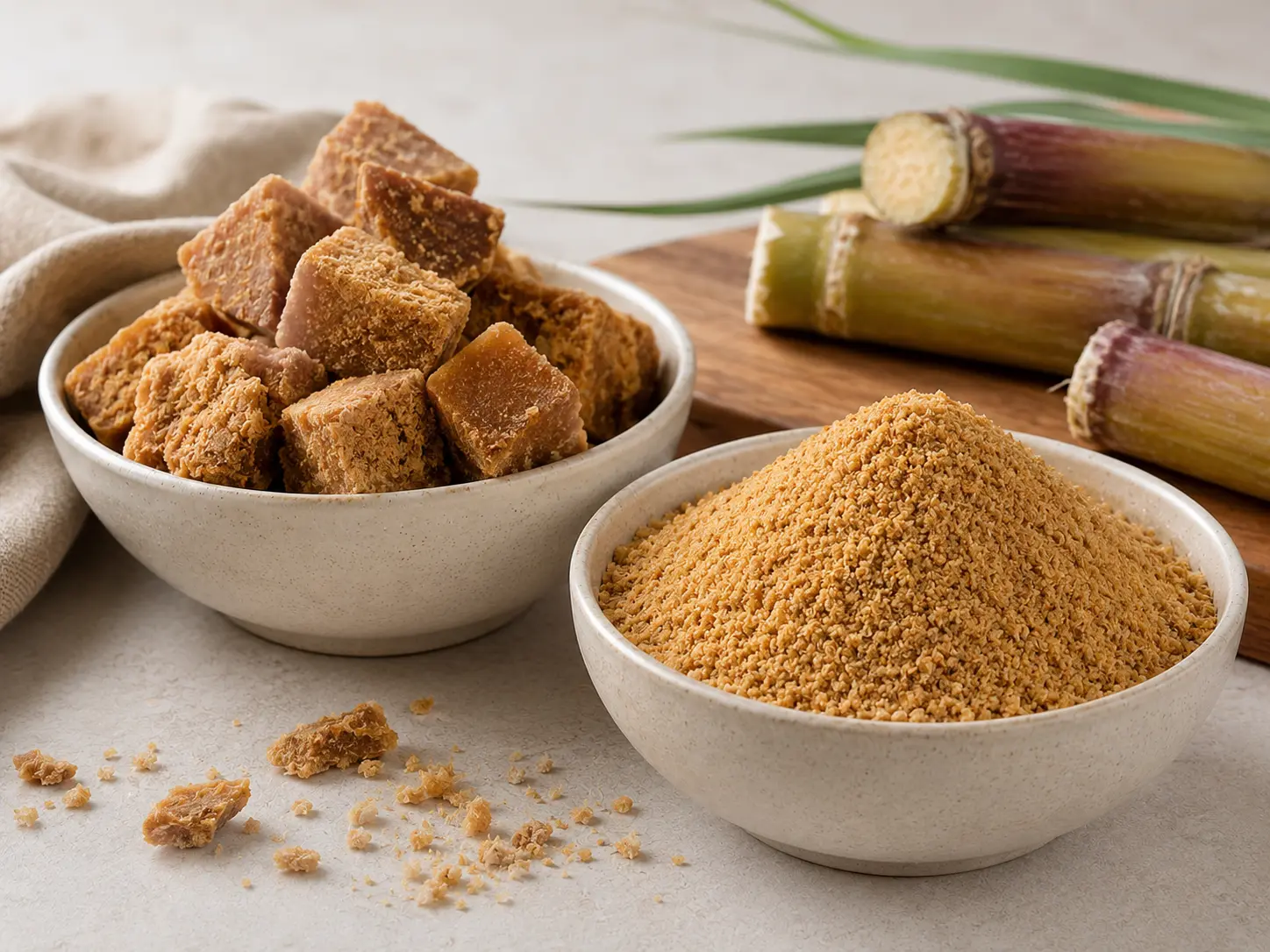
Indian Jaggery
Commercial product details, specification and sourcing requirement.
Open product page ↗What determines jaggery price from India?
There is no commercially meaningful single “India price”. A usable quote is a specification + quantity + Incoterm + date + destination combination.
Sugar-cane availability and local sugar economics influence the base cost.
Blocks, cubes, granules and powder need different conversion and packing.
Tighter grade and process requirements can narrow supply.
Retail/customer specifications add laboratory and documentation cost.
Bulk versus private-label packaging changes unit economics sharply.
If classified under 1701, CETA does not liberalise the UK tariff; model live duty into landed cost.
Build a working cost before you negotiate.
Duty and VAT are editable inputs because classification, preference and tax treatment must be confirmed for the actual shipment.
Planning tool only. Customs value, duty, VAT and recoverability depend on the actual transaction and current UK rules.
Do not assume a preferential rate for HS 1701.
The UK schedule marks 1701 as U. Use this panel to model the live duty rate you confirm for the actual commodity line.
Confirm the exact jaggery classification and enter the live UK duty rate in the landed-cost planner.
Planning arithmetic only; verify the tariff measure.
Estimate premium from an insured-value basis.
The insurer rate is deliberately left to the buyer because cover and pricing depend on cargo, route, packing and policy terms.
Arithmetic planner only; not an insurance quotation or recommendation of cover.
Turn tonnes into packs and pallets.
Useful for RFQ planning. Final pallet pattern, container payload and carrier restrictions must be confirmed operationally.
How to evaluate an Indian jaggery supplier.
Supplier selection should test capability, not marketing claims. The useful question is whether the operation can repeatedly meet your measurable specification, evidence it and ship it.
Form and composition and agreed acceptance limits.
Lot-specific lab capability, COA scope and external testing route.
Applicable food-safety/quality systems and site evidence.
Sugar cane origin, lot identity and production records.
Food-contact liner, sealing, net weight, pallet and export marks.
Real output for the required grade and repeat-order ability.
Commercial documents, origin evidence and shipping coordination.
Quotation clarity, payment terms, change control and communication discipline.
Red flags that deserve a second check
If Indian Jaggery is classified under HS 1701, CETA does not provide a UK tariff preference.
The agreement entered into force on 15 July 2026. The UK schedule marks heading 1701 as staging category U; Annex 2A says U goods receive no preferential customs duty concession under the agreement. Exact classification remains the first decision.
Use this only if the actual composition and form support heading 1701.
Do not build the commercial case around a 0% CETA duty assumption.
The exact commodity line, duty and any measures must be confirmed for the shipment date.
“Made in India” does not override a tariff exclusion.
Origin and tariff staging are separate gates. Even an Indian-origin product does not receive a CETA tariff concession where the UK schedule lists the actual tariff line as U. If formulation places the goods outside 1701, classify again before drawing a conclusion.
Annex 2A defines category U as excluded from UK tariff-reduction commitments. The UK schedule lists 1701 — cane or beet sugar and chemically pure sucrose, in solid form — as U.
UK–India CETA Chapter 2 ↗Classification is unusually important because tariff treatment can change the whole landed-cost case.
Many solid cane jaggery products can fall in HS 1701, but exact classification depends on composition and form. The UK CETA schedule lists 1701 as U, meaning no preferential tariff concession under the agreement. Food-safety, labelling and customs obligations still apply.
Lock the actual jaggery composition, form and process declaration.
Obtain the live UK commodity code; do not copy a code from another jaggery product.
If the goods are 1701, model the live non-preferential UK duty because CETA does not liberalise that heading.
Apply hygiene, contaminant, traceability and end-use controls.
Validate retail/private-label composition and claims before production.
Keep batch, specification, tests, invoice, packing and customs evidence together.
Not if the actual goods are classified under 1701: the UK schedule marks 1701 as U. Re-check classification and the live tariff for the specific product.
Use the live official source immediately before dispatch because product-country measures, documentary requirements and implementation details can change.
Build the acceptance standard before the shipment exists.
Testing and inspection only become useful when tied to a written specification and a decision rule: pass, hold, investigate or reject.
Stability, storage and handling control.
Supplier COA, inspection or external accredited laboratory as requiredBuyer / legal acceptance against the approved specification.
Supplier COA, inspection or external accredited laboratory as requiredFood-safety / customer acceptance.
Supplier COA, inspection or external accredited laboratory as requiredContaminant assurance against buyer/legal limits.
Supplier COA, inspection or external accredited laboratory as requiredBuyer / legal acceptance against the approved specification.
Supplier COA, inspection or external accredited laboratory as requiredPhysical cleanliness and quality.
Supplier COA, inspection or external accredited laboratory as requiredCustomer formulation and appearance standard.
Supplier COA, inspection or external accredited laboratory as requiredBuyer / legal acceptance against the approved specification.
Supplier COA, inspection or external accredited laboratory as requiredEvidence tells you what was checked. The buying system still has to decide whether the scope, method, lot identity and limits are adequate.
Documents a UK buyer should expect in the workflow.
The exact set depends on Incoterm, product, preference claim, customer standard and customs route. This is a commercial working set, not a claim that every document is legally mandatory in every case.
Commercial invoice
Seller, buyer, goods description, values, currency, Incoterm and transaction details.
Seller/exporterPacking list
Packages, weights/counts, dimensions, marks and packing details.
Seller/exporterBill of Lading
Sea-freight document linking shipper, consignee, cargo and carriage.
Carrier / freight routeProof of origin
Origin evidence when a CETA preference claim is being made.
Preference-route dependentCertificate of Analysis
Lot/order quality results against the approved specification.
Supplier / laboratory / inspectorLaboratory / test report
Independent or specified testing where required.
Laboratory / test houseApproved specification
The document that makes acceptance measurable and prevents quotation drift.
Buyer + supplier approvalInspection / release record
Pre-shipment or production-stage evidence where the QC plan requires it.
Supplier / inspectorFOB vs CFR vs CIF: compare responsibility, not just the headline price.
Always name the port or place and the applicable Incoterms version in the contract. This is a buyer-oriented summary, not a substitute for the full ICC rules.
Useful when the buyer wants control over ocean freight and forwarder.
Seller books freight; buyer keeps insurance control.
Convenient freight basis, but destination costs still need separating.
Two jaggery prices quoted on different Incoterms as if they were the same offer.
Freight, insurance basis, destination handling, clearance, duty treatment and inland delivery can change the real comparison.
Build the route around inventory risk and total cost.
For indian jaggery, the cheapest ocean rate is only one variable. Packing density, handling, port choice, destination charges and warehouse timing can matter just as much.
Inventory risk matters more than container economics.
Smaller volume can reduce stock exposure and help first-order validation, but consolidated freight can bring more handling and higher cost per packs/tonnes.
Volume, repeat demand and pack density justify dedicated capacity.
Container economics can improve at scale, but check payload/cube, arrival inventory and working-capital exposure first.
Insurance should follow the risk transfer in the contract.
First understand who carries risk at each stage under the agreed Incoterm, what the cargo policy covers and what exclusions apply to the goods and route.
Packing and container-condition discipline protect the goods.
Carton/bag, pallet and internal pack integrity matter across transhipment.
Delay itself may not be insured; understand policy wording and stock impact.
Check cargo-policy response, general-average position and documentary process.
A planning premium can be calculated from an insured value and an insurer-provided rate, but the objective is cover that matches the cargo, route, packing, risk transfer and loss scenario that matters to the buyer.
The sourcing decision should remain connected from RFQ to delivery.
This operating sequence keeps product, supplier, commercial and shipment decisions from becoming separate conversations.
Specification · quantity · destination
Capability · origin · capacity
Spec · QC/tests · documents
Price · Incoterm · lead time
Terms · PO · payment
Inputs · batch/order · packing
Testing · inspection · acceptance
Invoice · packing · origin · transport
Freight · insurance · tracking
Declaration · preference · controls
Warehouse · receipt · close-out
Turn the research into a sourcing requirement.
Submit the product, specification, quantity, destination and target delivery. SHELROCK can structure the remaining commercial questions around the requirement.
The terms a UK buyer will encounter in this transaction.
Short definitions for procurement, customs, quality and logistics conversations.
International harmonised classification framework used to identify goods.
The detailed UK classification used to apply customs measures and make declarations.
A reduced or nil rate available when goods satisfy a trade agreement and the claim is supported.
Criteria deciding whether goods qualify as originating under a trade agreement.
The key origin/tariff concept for this product under the UK–India CETA route.
A preference route where the importer holds sufficient evidence that the goods are originating.
An origin document issued by an authorised body under the relevant route.
Economic Operators Registration and Identification number used for Great Britain customs activity.
Certificate of Analysis — reported quality/test results for the product or batch.
Minimum order quantity accepted for a specification/SKU.
Free On Board — seller delivers on board the vessel at the named port under the ICC rule.
Cost and Freight — seller pays main carriage to the named destination port.
Cost, Insurance and Freight — seller arranges main carriage and required insurance to the named port.
Less than Container Load — cargo shares container capacity.
Full Container Load — dedicated container movement, subject to payload/cube and carrier rules.
The valuation basis used to calculate customs duty under customs valuation rules.
Total buyer cost to the chosen destination after relevant product, freight, customs and delivery costs.
Frequently asked questions.
Commercial, customs, sourcing, compliance and logistics questions UK buyers commonly ask before importing indian jaggery from India.
Can I import indian jaggery from India into the UK?+
Yes. A UK buyer can import indian jaggery from India, subject to correct classification, customs formalities, the product-specific compliance route and the facts of the consignment.
What is the HS code for indian jaggery?+
The working HS family in this guide is 1701: Cane or beet sugar and chemically pure sucrose, in solid form — indicative family for many jaggery products; exact classification depends on the goods. Treat it as an indicative classification starting point and verify the live UK commodity code for the exact goods before declaration.
Is jaggery duty-free from India under the UK–India CETA?+
Not if the actual goods are classified under heading 1701. The UK CETA schedule marks 1701 as U, which is excluded from tariff-reduction commitments. Confirm the final classification and live UK tariff.
Do I need a GB EORI number?+
A business carrying out customs activities in Great Britain will normally need the appropriate GB EORI registration.
Should I confirm the commodity code before ordering?+
Yes. Classification affects tariff measures, origin analysis and sometimes the compliance route. Confirm it against the actual product, construction, composition and processing before the commercial order is locked.
What should I put in the RFQ?+
At minimum define form and composition, quantity, destination, packing, testing/quality acceptance, target delivery, Incoterm and any CETA-origin requirement.
What affects jaggery price from India?+
Raw-material/fabric cost, the specification, testing/QC, packaging, order scale, SKU or lot complexity, lead time, Incoterm and freight can all change the real price.
Should I compare FOB or CIF?+
Compare offers on one common basis. FOB can give the buyer more control over main carriage; CIF includes seller-arranged freight and required insurance to the named port but does not include every destination cost.
What is landed cost?+
Landed cost combines the relevant goods value, freight, insurance, customs duty where applicable, clearance, destination handling and inland delivery to the chosen point. Tax treatment should be assessed for the actual importer.
Can I use a static internet price?+
Not for a serious B2B decision. Specification, testing, order size, packing, Incoterm, exchange rates and freight can materially change the commercial price.
What MOQ is typical?+
There is no universal MOQ. It depends on the supplier, specification, packing, testing/QC, production economics and whether the order is a sample, trial, LCL or container-scale programme.
Can I request a sample first?+
Yes, subject to supplier availability. Approve the sample against the same measurable specification and acceptance criteria intended for bulk supply.
How should I compare two Indian suppliers?+
Place both offers on the same specification, quantity, pack, testing/QC, Incoterm and destination basis, then compare evidence, capacity, lead time, payment terms and total landed cost.
What should I check about supplier capacity?+
Check realistic output for your exact grade/SKU, current production schedule, input availability, QC/testing lead time, packing capacity and repeat-order ability.
Should I use LCL or FCL?+
Compare total cost, handling risk, inventory exposure, packing density and destination charges. The cheapest ocean rate alone is not enough.
How should cargo insurance be estimated?+
For planning, use an insured value and a rate provided by the insurer or broker. Actual premium and cover depend on cargo, route, packing, policy wording and risk history.
What shipment documents should I expect?+
A typical working set includes commercial invoice, packing list, transport document, origin evidence where claiming preference, and product/quality documents required by the buyer or authorities.
Is a certificate of origin mandatory for every shipment?+
For a 1701 jaggery shipment, a CETA preference claim is not available because that heading is U. Origin documents may still be needed for other commercial or customs purposes depending on the shipment.
Does CETA remove product-safety or food-safety requirements?+
No. Tariff preference and compliance are separate. Relevant food, textile, product-safety, labelling, customs and restricted-product controls continue to apply.
How often should tariff and regulatory information be checked?+
Check again before quotation finalisation and before shipment wherever a measure can change. This guide uses a verification date rather than treating regulatory content as permanently static.
Which UK port should I use?+
Compare carrier service, freight, destination handling, customs arrangements, any required border controls and inland delivery to your warehouse. The best port is route-specific.
What is the fastest way to get a useful commercial quote?+
Send a complete brief: form and composition, quantity, destination, packing, testing/QC, target delivery, Incoterm preference and origin/compliance requirements.
Can SHELROCK source an unlisted specification?+
Yes. Submit the exact product, quantity, specification, testing/QC, packing, destination and delivery requirement even if the variant is not shown on the catalogue.
Can SHELROCK coordinate documents and logistics?+
The SHELROCK workflow is designed to connect supplier capability, commercial validation, quality readiness, documentation and trade movement, subject to the scope agreed for the requirement.
Is a supplier COA enough?+
A COA is useful evidence but not automatically sufficient. Check that batch identity, test method, scope and acceptance limits match the approved specification.
What food testing should I request?+
Testing should follow the product, end use and current controls. Common commercial checks for this product include Moisture, Composition / sugar profile where required, Microbiology, Heavy metals where required, Pesticide residues where required, plus any customer-specific parameters.
Do I always need a health certificate?+
Not automatically just because the product is jaggery. Confirm the exact formulation/classification and check the current GB product-country restriction list before shipment; food-safety and customs requirements still apply.
Can I rely on the supplier saying “Indian origin”?+
Do not use an origin statement to infer a CETA tariff saving where the tariff line is excluded. Classification and staging come first.
How should shelf life be specified?+
State total shelf life where relevant and the minimum remaining shelf life required at shipment or delivery, together with storage conditions and packaging assumptions.
Should I define the pack before asking for price?+
Yes. Pack weight, liner/barrier, outer packaging, palletisation and marks affect production cost, freight density, damage risk and warehouse handling.
Primary sources used for this guide.
Regulatory, tariff and origin statements were checked against official/current sources on 25 August 2026. Live tariff and control sources remain the final reference because measures and implementation details can change.
How SHELROCK builds this intelligence.
We separate legal/tariff rules, official control signals and commercial interpretation. Official sources establish the rule or classification signal; SHELROCK then explains the procurement implication, calculation logic or sourcing decision. Estimates and buyer tools are planning aids, not government measurements or customs rulings.
Classification, customs duty, origin qualification, food controls, VAT and documentary requirements depend on the exact goods, transaction, date and destination. Verify the live UK tariff and relevant authority guidance before making a customs or compliance decision.